.png?w=1024&h=559)
Quick Summary: Can I use my glasses prescription for contacts?
-
The Verdict: No. You cannot use a glasses prescription for contact lenses.
-
The Reason: Glasses sit ~12mm from your eyes; contacts sit directly on the eye (0mm). This "Vertex Distance" changes the optical power required.
-
The Risk: A glasses prescription lacks Base Curve and Diameter—two critical numbers for a safe fit. Guessing can lead to corneal damage and blurred vision.
The Short Answer
If you are currently holding a prescription for eyeglasses, you cannot use those numbers to order contact lenses.
While the numbers may look similar, glasses and contacts are two entirely different medical devices. Using a glasses prescription for contacts isn't just inaccurate—it can lead to distorted vision, headaches, and in some cases, long-term damage to your eye health.
However, getting the right numbers is only half the battle. Once you have a contact lens prescription, the material you choose matters just as much as the power.
The Physics: Why the Numbers Change (Vertex Distance)
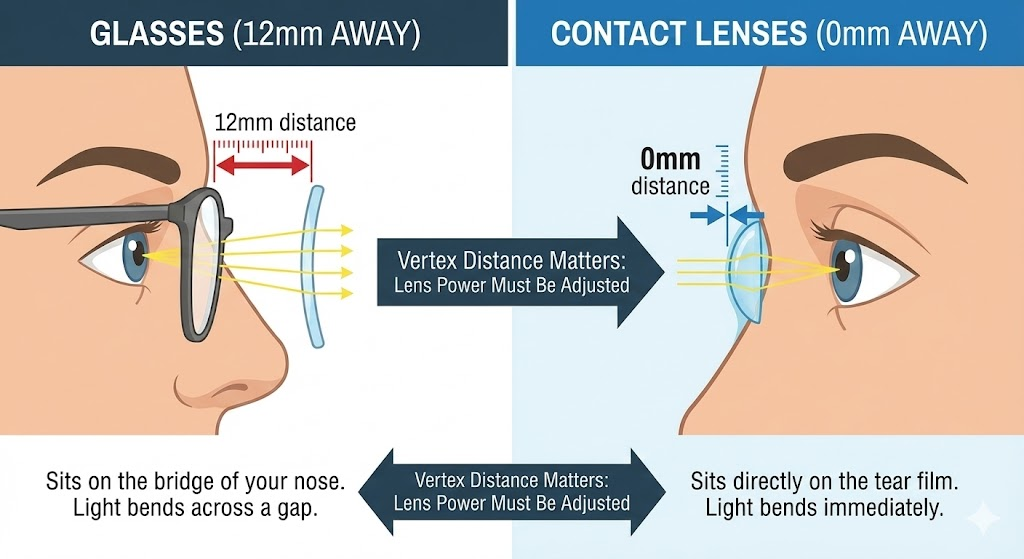
The main reason you can’t swap prescriptions is a concept called Vertex Distance.
-
Glasses sit about 12 millimeters away from your eyes (on the bridge of your nose).
-
Contact Lenses sit directly on the tear film of your eye (0 millimeters away).
That tiny 12mm gap changes how light bends before it hits your retina. To correct your vision accurately, the power of the lens must be adjusted based on its location:
-
For Nearsightedness (Minus power): You generally need less power in a contact lens than in glasses.
-
For Farsightedness (Plus power): You generally need more power in a contact lens.
⚠️ Warning: Do not try to calculate this yourself. The math involves complex optical formulas, and guessing often leads to severe eye strain.
The "Hidden" Specs: Base Curve and Diameter
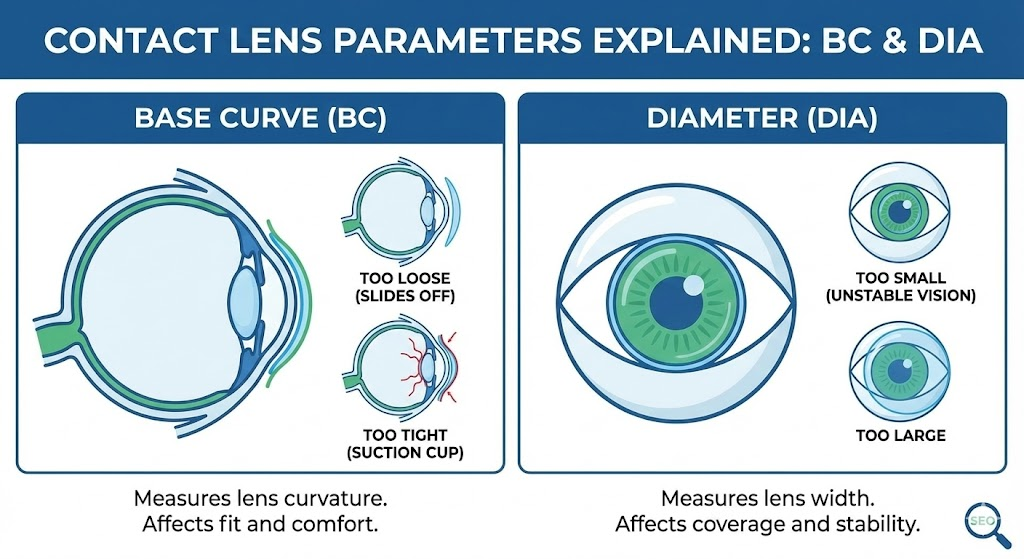
Even if the power conversion were perfect, a glasses prescription is missing two critical numbers required for a safe contact lens fit:
-
Base Curve (BC)
This measures the curvature of the back of the lens. Your eye isn't perfectly round; it has a specific steepness.
-
The Risk: If the BC is wrong, the lens will either slide off (too loose) or act like a suction cup (too tight), potentially cutting off blood flow to the cornea.
-
Diameter (DIA)
This is the physical width of the lens. If the diameter is incorrect, the lens won't cover your cornea properly, leading to unstable vision and irritation.
Beyond the Prescription: Why Material Matters
Here is the secret most people miss: Not all contact lenses are created equal.
Once you have your contact lens prescription, you need to ensure the lens you wear allows your eyes to "breathe". Older hydrogel materials often blocked oxygen, leading to the "red eye" look and fatigue after a long day of wear.
To avoid this, you should look for Third-Generation Silicone Hydrogel lenses. Here are the three "Gold Standard" specs you should demand for your eye health:
-
Extreme Breathability (Dk/t)
Your cornea needs oxygen from the air to stay healthy. If a lens blocks that oxygen, your eyes can experience hypoxia (oxygen starvation), causing red veins to appear.
-
The Industry Standard: Many standard daily lenses have an oxygen transmissibility (Dk/t) of around 80–100.
-
The Upgrade: We engineered our Olifilcon B daily lenses to feature a Dk/t of 150. This near-perfect oxygen flow ensures your eyes look as white and clear at 9 PM as they did at 9 AM.
-
The "Water Content" Myth vs. True Moisture
When shopping for contacts, most people look for a high "Water Content" percentage, assuming more water equals more hydration. This is a marketing myth.
High water content does not mean the lens stays wet; it simply means the lens needs more water to maintain its shape. In dry environments (like an air-conditioned office), a high-water lens can act like a drying sponge—drawing moisture out of your natural tear film to keep itself saturated.
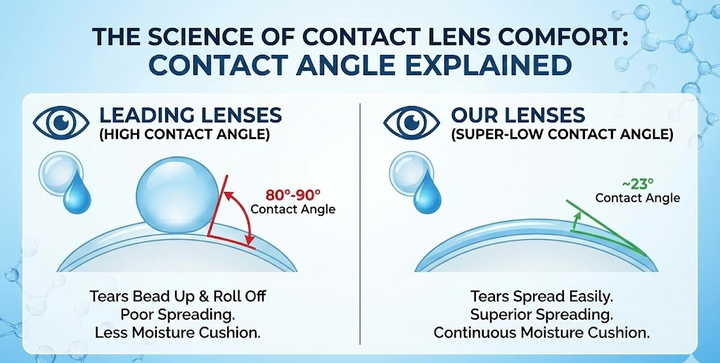
The Solution: Look for Contact Angle
Instead of water content, look at Contact Angle—the measure of how easily tears spread across the lens surface
-
High Angle (80°-90°): Tears bead up and roll off (common in many leading lenses).
-
Low Angle (~23°): Our lenses achieve a super-low contact angle. By utilizing natural moisturizing agents like Hyaluronic Acid and Alginic Acid, we lock moisture in rather than just holding it. This mimics your eye’s natural tear film, preventing that "drying sponge" effect entirely.
-
All-Day Softness (Modulus)
Some silicone lenses allow high oxygen but feel stiff and plastic-like in the eye. This stiffness is measured by "Modulus".
-
The Sweet Spot: You want a lens that is soft enough to be comfortable but firm enough to handle easily. Our lenses feature a modulus of 0.5 to 0.6 MPa, providing a "barely there" feeling while remaining easy to insert and remove.
Special Cases: Astigmatism and Presbyopia
If you have astigmatism or need reading help (presbyopia), the difference between glasses and contacts is even more pronounced.
-
Astigmatism: Glasses have a precise axis (e.g., 162°), but contact lenses usually come in steps of 10° (e.g., 160° or 170°). A doctor must determine which step provides the clearest vision.
-
Presbyopia: Unlike the bifocal line in glasses, multifocal contacts use concentric rings of power to switch seamlessly between near, intermediate, and distance vision.
Final Verdict: How to Take Control of Your Vision
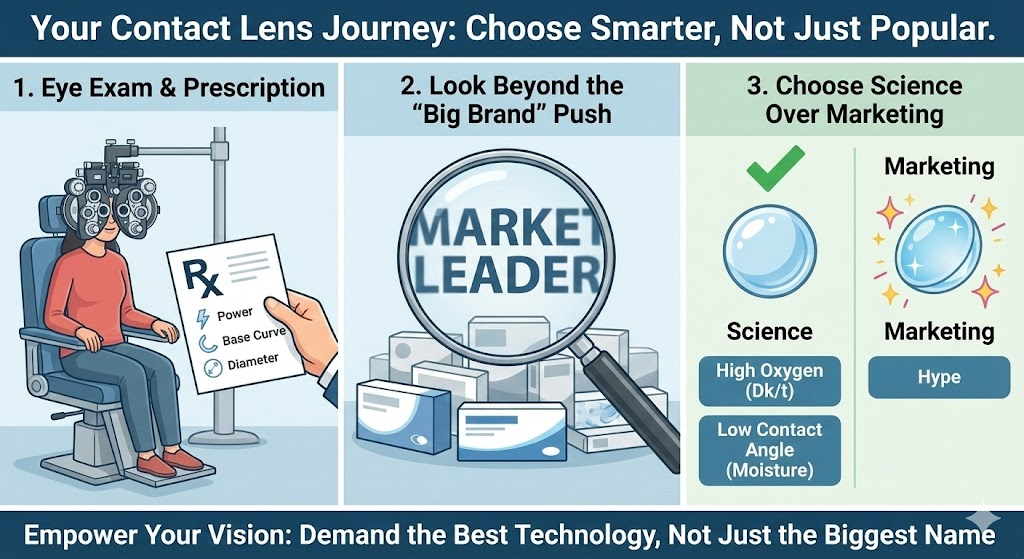
Step 1: Secure Your Prescription
Visit your optometrist for your eye health check and fitting. By law, they must provide you with a copy of your prescription parameters (Power, Base Curve, and Diameter).
Step 2: Look Beyond the "Big Brand" Recommendation
It is an industry reality that many clinics recommend specific "Big Brand" lenses due to commercial partnerships. This often means patients are prescribed older technology simply because it is the "status quo".
Step 3: Choose Science Over Marketing
Now that you understand the metrics that actually matter—Oxygen Transmissibility (Dk/t) and Surface Moisture (Contact Angle)—you can see past the label and choose a lens that is technically superior.
You have the numbers. Now, give them the home they deserve.
moodycontact, moodycontact, moodycontact, moodycontact, moodycontact, moodycontact, moodycontact, moodycontact, moodycontact, moodycontact, moodycontact, moodycontact, moodycontact, moodycontact, moodycontact, moodycontact, moodycontact, moodycontact, moodycontact, moodycontact, moodycontact, moodycontact, moodycontact, moodycontact, moodycontact, moodycontact, moodycontact, moodycontact, moodycontact, moodycontact, moodycontact, moodycontact, moodycontact, moodycontact, moodycontact, moodycontact, moodycontact, moodycontact, moodycontact, moodycontact, moodycontact, moodycontact, moodycontact, moodycontact, moodycontact, moodycontact, moodycontact, moodycontact, moodycontact, moodycontact, moodycontact, moodycontact, moodycontact, moodycontact, moodycontact, moodycontact, moodycontact, moodycontact, moodycontact, moodycontact, moodycontact, moodycontact, moodycontact, moodycontact, moodycontact, moodycontact, moodycontact, moodycontact, moodycontact, moodycontact, moodycontact, moodycontact, moodycontact, moodycontact, moodycontact, moodycontact, moodycontact, moodycontact, moodycontact, moodycontact, moodycontact, moodycontact, moodycontact, moodycontact, moodycontact, moodycontact, moodycontact, moodycontact, moodycontact, moodycontact, moodycontact, moodycontact, moodycontact, moodycontact, moodycontact, moodycontact, moodycontact, moodycontact, moodycontact, moodycontact, moodycontact, moodycontact, moodycontact, moodycontact, moodycontact, moodycontact, moodycontact, moodycontact, moodycontact, moodycontact, moodycontact, moodycontact, moodycontact, moodycontact, moodycontact, moodycontact, moodycontact, moodycontact, moodycontact, moodycontact, moodycontact, moodycontact, moodycontact, moodycontact, moodycontact, moodycontact, moodycontact, moodycontact, moodycontact, moodycontact, moodycontact, moodycontact, moodycontact, moodycontact, moodycontact, moodycontact, moodycontact, moodycontact, moodycontact, moodycontact, moodycontact, moodycontact, moodycontact, moodycontact, moodycontact, moodycontact, moodycontact, moodycontact, moodycontact, moodycontact, moodycontact, moodycontact, moodycontact, moodycontact, moodycontact, moodycontact, moodycontact, moodycontact, moodycontact, moodycontact, moodycontact, moodycontact, moodycontact, moodycontact, moodycontact, moodycontact, moodycontact, moodycontact, moodycontact, moodycontact, moodycontact, moodycontact, moodycontact, moodycontact, moodycontact, moodycontact, moodycontact, moodycontact, moodycontact, moodycontact, moodycontact, moodycontact, moodycontact, moodycontact, moodycontact, moodycontact, moodycontact, moodycontact, moodycontact, moodycontact, moodycontact, moodycontact, moodycontact, moodycontact, moodycontact, moodycontact, moodycontact, moodycontact, moodycontact, moodycontact, moodycontact, moodycontact, moodycontact, moodycontact